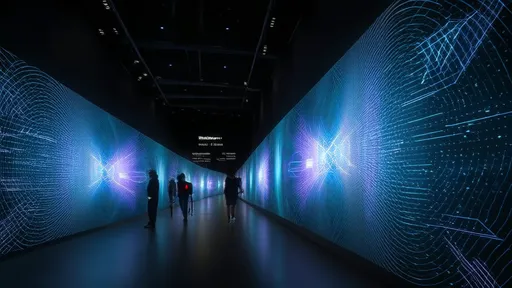
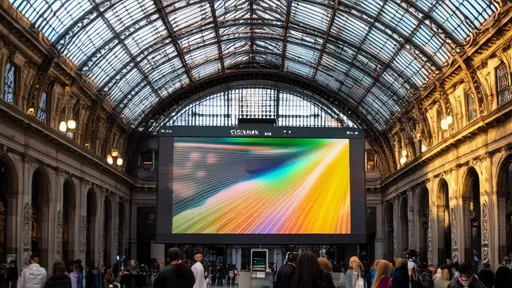
Milan's historic Central Station has become the unlikely canvas for a groundbreaking digital art exhibition that challenges conventional notions of gallery space and public engagement. The CDSA Milan Exhibition, running through the autumn season, has transformed the station's main concourse into a pulsating digital gallery where thousands of commuters encounter contemporary art during their daily travels.
The ambitious project represents a collaboration between the Contemporary Digital Society of Arts and Italian railway authorities, marking one of the most significant integrations of digital art into public infrastructure in recent European memory. What makes this exhibition particularly remarkable is its complete departure from traditional exhibition formats—there are no white walls, no velvet ropes, and certainly no hushed tones. Instead, massive high-resolution screens mounted throughout the station display rotating collections of digital artworks that respond to the rhythm of train schedules and passenger flow.
Walking through the station during morning rush hour reveals the exhibition's clever design. As commuters hurry toward their platforms, the digital displays shift to more calming, meditative pieces—slow-moving abstract forms and tranquil color fields that provide visual respite from the morning chaos. The artists have specifically created works that acknowledge the temporal nature of the viewing experience; these aren't pieces meant for prolonged contemplation but rather brief, meaningful encounters that register differently with each passerby.
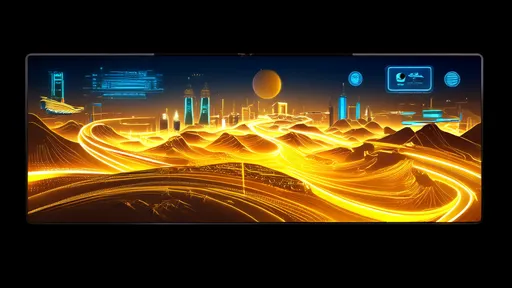
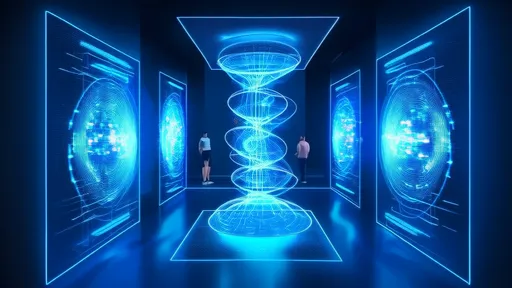
The central installation, positioned above the main ticket hall, features a continuously evolving generative artwork that pulls data from train schedules, weather patterns, and even social media feeds from within the station. The result is a living, breathing piece that reflects the actual energy and mood of the space in real-time. During peak travel times, the visualization becomes more complex and dynamic, while late at night it settles into quieter, more minimal patterns.
What distinguishes this exhibition from previous attempts at public digital art is its thoughtful integration with the station's architecture. Rather than treating the screens as isolated objects, the curators have worked with the building's existing visual language. The digital artworks converse with the station's monumental fascist-era architecture, creating a fascinating dialogue between historical grandeur and contemporary digital expression. The marble surfaces and soaring ceilings provide a dramatic backdrop for the luminous screens, while the natural light filtering through the massive windows creates unexpected interactions with the digital displays throughout the day.
The exhibition features works from thirty-seven international digital artists, each responding to the unique challenge of creating art for a transient audience in a highly specific environment. Italian artist Giulia Conti's contribution uses facial recognition technology to create abstract portraits of passersby, though she's careful to note that the system doesn't store any personal data. "The work is about the beauty of anonymous connections in public spaces," Conti explains. "It captures the geometry of a face for just a moment, translates it into color and form, then lets it dissolve back into the digital stream—much like how we briefly connect with strangers in transit spaces before continuing on our separate ways."
British collective Digital Aesthetics has created a piece that responds to sound levels in the station, transforming the ambient noise of footsteps, conversations, and arriving trains into cascading visual patterns. During testing, they discovered that the distinctive sound of suitcase wheels on marble produces particularly interesting visual results, leading them to adjust their algorithms to better highlight this uniquely transit-related sonic signature.
The public response has been overwhelmingly positive, though notably different from traditional gallery reactions. Instead of standing and analyzing the works, most viewers experience them in glimpses—while waiting for a train, walking to a platform, or meeting someone in the station. This has led to interesting social media documentation of the exhibition, with commuters sharing brief videos and photos of their favorite pieces encountered during their daily routines. The station's Instagram location tag has become an unofficial extension of the exhibition, with thousands of posts showing how different people interact with the same artworks at different times of day.
Station manager Marco Bellini reports that the exhibition has had unexpected benefits beyond cultural enrichment. "We've noticed a measurable decrease in perceived wait times and an improvement in passenger mood metrics since the installation opened," he says. "There's something about encountering beauty unexpectedly during the daily grind that changes people's experience of transit. We're seeing more smiles, fewer complaints, and an overall more pleasant atmosphere in what can often be a stressful environment."
The educational component extends beyond the screens themselves. QR codes placed discreetly near each display allow interested viewers to access information about the artists and their creative processes. An accompanying audio guide available through a dedicated app provides commentary that can be enjoyed while waiting for trains. For those wanting deeper engagement, the CDSA has organized a series of artist talks and workshops in a converted storage space within the station, bringing the artistic community directly into the public sphere.
Critics have praised the exhibition for its democratic approach to art accessibility. Unlike traditional galleries that often carry unspoken barriers of class and education, this exhibition meets people exactly where they are—physically and psychologically. There's no admission fee, no dress code, and no expectation of prior art knowledge. The artworks have to communicate on their own terms, without wall text or docents to explain their meaning. This forced clarity has resulted in works that are intellectually substantial yet immediately engaging.
The technological infrastructure supporting the exhibition is as impressive as the art itself. The screens use advanced adaptive brightness technology to ensure optimal visibility regardless of changing natural light conditions throughout the day. A sophisticated content management system allows the curators to adjust the programming based on real-time analytics about which pieces resonate most with viewers at different times. The system also enables the inclusion of last-minute additions and responses to current events, keeping the exhibition feeling fresh and relevant throughout its run.
As the exhibition continues through the season, the organizers are already considering its legacy. Preliminary discussions are underway about making the digital art program a permanent feature of Milan Central Station, with rotating exhibitions that would keep the space dynamically engaged with contemporary art practice. Other major European train stations have expressed interest in developing similar programs, suggesting that this model could represent a new paradigm for bringing art to the public.
The success of the CDSA Milan Exhibition demonstrates that the future of art viewing may not be in dedicated cultural institutions alone, but in the creative reimagining of the public spaces we inhabit every day. By meeting people during their daily routines rather than asking them to make special trips to galleries, this approach has the potential to integrate art viewing into the fabric of ordinary life in ways that traditional museums can rarely achieve.
As dusk falls on the station and the digital artworks begin to glow more brightly against the darkening sky visible through the glass roof, the space transforms into something truly magical. Commuters slowing their pace, children pointing at particularly vibrant pieces, tourists capturing the moment—all become part of the living artwork. In bringing digital art to Central Station, the CDSA hasn't just created an exhibition; they've created a new kind of public square where art and life intersect in the most natural way imaginable.
By William Miller/Oct 27, 2025
By /Oct 27, 2025
By /Oct 27, 2025
By /Oct 27, 2025
By Rebecca Stewart/Oct 27, 2025
By /Oct 27, 2025

By /Oct 27, 2025

By /Oct 27, 2025
By /Oct 27, 2025
By /Oct 27, 2025
By Samuel Cooper/Oct 27, 2025
By /Oct 27, 2025
By /Oct 27, 2025
By /Oct 27, 2025

By /Oct 27, 2025
By /Oct 27, 2025

By /Oct 27, 2025
By /Oct 27, 2025
By /Oct 27, 2025
By /Oct 27, 2025
