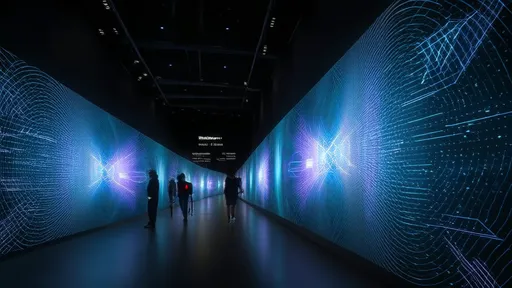
In the hushed galleries of London's Tate Modern, visitors don VR headsets and find themselves walking through a digital reconstruction of a Cambodian rainforest. At teamLab's Borderless museum in Tokyo, children chase digital butterflies that flutter across walls and floors, leaving trails of light in their wake. Meanwhile, in a warehouse in Brooklyn, participants in an immersive theater production find themselves making moral choices that alter the narrative's outcome. These disparate experiences share a common thread: they all exist in the liminal space between the virtual and the real, a frontier that immersive art is exploring with unprecedented vigor.
The very definition of art is being stretched and reshaped. No longer confined to static objects on walls or pedestals, art is becoming an environment, an event, a shared reality. This shift is powered by a suite of technologies—Virtual Reality (VR), Augmented Reality (AR), projection mapping, and responsive soundscapes—that are moving from the fringes of experimental art into the mainstream cultural lexicon. We are witnessing the rise of the experience economy within the arts, where the value lies not in owning a physical artifact, but in the memory and emotional impact of a lived moment. This is not merely art you look at; it is art you inhabit.
The Technological Canvas: From Pixels to Presence
The tools enabling this revolution are evolving at a breathtaking pace. Virtual Reality, once clunky and isolating, now offers high-fidelity visuals and increasingly sophisticated haptic feedback, creating a convincing sense of presence—the feeling of "being there" in a digitally constructed world. Artists like Laurie Anderson are using VR to create profound, personal journeys. Her installation "Chalkroom" allows participants to fly through a vast, virtual space filled with handwritten words and stories, making the audience not just viewers but navigators of a narrative landscape.
Parallel to VR, Augmented Reality is blurring the lines in the physical world. Through the lens of a smartphone or AR glasses, digital sculptures can appear to sit in a public park, and historical figures can seem to walk through city streets. This technology superimposes the fantastic onto the familiar, challenging our perception of our immediate environment. It creates a layered reality, where the virtual and the physical coexist and interact in real-time, turning the entire world into a potential gallery space.
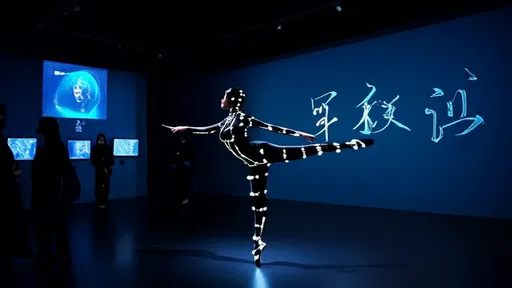
Beyond headsets and screens, projection mapping has transformed architecture and stage design. By precisely aligning projected images with irregular surfaces, artists can make buildings breathe, melt, or tell stories. These large-scale public spectacles democratize immersive art, creating shared, awe-inspiring moments for thousands of people simultaneously, without the need for personal hardware.
The Human Element: Emotion, Interaction, and Co-Creation
At its core, the power of immersive art lies in its ability to engage the human sensorium more completely than traditional forms. It is a deeply emotional and psychological endeavor. By surrounding the participant with sight, sound, and sometimes even touch and smell, these experiences can trigger stronger emotional responses and forge deeper memory traces. An immersive installation about climate change, for instance, can make the abstract concept of rising sea levels feel immediate and terrifying by virtually submerging the viewer, creating an empathy that a news article or documentary might not.
Furthermore, interactivity is a cornerstone of this new art form. The audience is often an active participant, their movements, choices, and even biometric data shaping the artwork itself. In works by collectives like Meow Wolf or Punchdrunk, there is no single, passive narrative. Instead, visitors become explorers, detectives, or even characters, piecing together their own unique story from the environment. This transforms the artistic experience from a lecture into a conversation. The artwork is no longer a finished product but a dynamic system, and the viewer becomes a co-creator.
This shift raises fascinating questions about authorship and interpretation. If no two people have the same experience, can we say there is one definitive artwork? The art becomes a set of rules and possibilities, a playground for human agency, where meaning is generated through the interaction between the system and the individual.
Navigating the Boundary: Challenges and Critical Questions
As the boundary between virtual and real softens, it presents a host of challenges. One significant concern is the paradox of immersion. The very technology that creates profound feelings of presence can also be physically isolating. A person in a VR headset is, in the physical world, cut off from those around them. This creates a tension between the shared social experience of visiting a museum or theater and the intensely personal, solitary journey that these technologies can facilitate. Artists and institutions are grappling with how to design for shared immersion, creating experiences that connect people rather than separate them.
Ethical considerations are also coming to the fore. The data collected from participants—their gaze, their movements, their choices—is incredibly valuable. Who owns this data? How is it used? The potential for manipulation is real, as immersive environments can be powerfully persuasive. The line between artistic influence and psychological manipulation is a thin one that requires careful ethical frameworks.
There is also a risk of the spectacle overshadowing the substance. As the "wow factor" of the technology becomes more accessible, there is a danger that artists will rely on technical wizardry at the expense of narrative depth, emotional resonance, or critical thought. The most successful works are those where the technology serves the artistic concept, not the other way around.
The Future Unfolds: Hybrid Realities and New Aesthetics
Looking ahead, the future of immersive art points toward even more seamless integration. The concept of the metaverse—a persistent, shared, virtual space—presents a new frontier. Imagine digital art installations that exist permanently in a virtual world, continuously evolving and accessible to anyone, anywhere. This could democratize access to art in unprecedented ways, breaking down geographical and socioeconomic barriers.
We are also moving toward hybrid realities, where the distinction between the virtual and the physical becomes almost meaningless. With advancements in haptic suits, brain-computer interfaces, and spatial computing, the digital will not just be something we see and hear, but something we can feel and manipulate as if it were physical. This will give rise to entirely new artistic mediums and aesthetics that we can scarcely imagine today.
Ultimately, the journey of immersive art is not about abandoning the real world for a virtual one. It is about expanding our understanding of reality itself. It is a tool for enhancing empathy, for exploring complex ideas in visceral ways, and for creating new forms of shared human experience. As we continue to navigate this blurred boundary, the most profound works will be those that remind us of our own humanity, using the virtual not as an escape, but as a mirror to reflect upon, question, and deepen our connection to the real world and to each other. The canvas is expanding, and the art is just beginning.
By William Miller/Oct 27, 2025
By /Oct 27, 2025
By /Oct 27, 2025
By /Oct 27, 2025
By Rebecca Stewart/Oct 27, 2025
By /Oct 27, 2025
By /Oct 27, 2025
By /Oct 27, 2025
By /Oct 27, 2025
By /Oct 27, 2025
By Samuel Cooper/Oct 27, 2025
By /Oct 27, 2025
By /Oct 27, 2025
By /Oct 27, 2025
By /Oct 27, 2025
By /Oct 27, 2025
By /Oct 27, 2025
By /Oct 27, 2025
By /Oct 27, 2025
By /Oct 27, 2025
